
Alla LANDAR: Funeral services amid the sounds of explosions in the first weeks of the war
With the onset of the war, the workload in the funeral industry increased, while the conditions and nature of the work became so complicated that it became impossible to adapt to everything. The war divided life into “before” and “after” for everyone, and for funeral-service providers, it marked the beginning of truly severe trials. Today I will share some memories of those first days and weeks, using as an example the work of our company’s funeral-service office on Oranzhereina Street. During the war, this place became the epicenter of grief and mourning…
That morning of February 24, when Kyiv residents awoke to the sounds of explosions and sirens, hurriedly searched the Internet for news, and called their relatives and friends, the war had already begun counting its first hundreds of casualties. Some instantly decided to evacuate their families; others tried to evacuate children, find transportation, or simply find a place to refuel their own vehicles.
Many funerals were scheduled for that Thursday, so we had to get to work immediately. It was becoming clear that the missile strikes would bring many tragic reports. The regular work schedule collapsed: some people were unable to reach their workplace on time, others could not get there at all. All morgues—like our own offices and all locations where bodies were released for burial—handled urgent issues as they came, literally on the fly. This concerned both people and transportation, which that day was not available in full. Moreover, not all forensic experts were able to come to work, and not only in the first days. Complications multiplied.
The war was rapidly approaching Kyiv from the west and north. Fighting was underway in Hostomel, Bucha, Borodianka, Irpin, Brovary, and at the Chornobyl plant. Sabotage groups were already active in the capital itself: it grew hot in Obolon, gunfire was heard in central districts, and enemy equipment was burning on Peremohy Avenue.
Despite everything, not a single funeral was canceled. There were inevitable delays—mainly in timing—but all funerals scheduled for the 24th and the following days were completed. In the first weeks, only our company and the municipal special-combinate were operating in Kyiv. Even the crematorium experienced disruptions, while the doors of other funeral-service providers simply closed. This was especially noticeable on Oranzhereina Street, where perhaps the largest concentration of such businesses in one block exists in Ukraine. The crematorium continued working, but most of the female staff had left the city to save their children and grandchildren, which caused repeated delays due to difficulties with timely paperwork.
The situation with cemeteries was also complicated. The municipal cemetery—Berkivtsi—suffered an actual airstrike. Missile craters appeared in sections 78 and 79, while grave structures in sections 68, 69, and 90 were damaged or completely destroyed. Saboteurs had also been active there, and as a result, certain areas were mined.
The main and only operational Northern Cemetery simply closed its gates due to fighting on its grounds. Missiles were flying overhead; enemy aircraft and helicopters were maneuvering; battles for Brovary and strategic approaches to Kyiv continued.
Meanwhile, the Southern Cemetery, which still had several available plots, simplified its procedures and tried to accommodate people: families of the deceased or fallen did not even need to come in person to place an order. It was enough to call, having only the medical death certificate—before even receiving the official document.
Our company tried to do everything possible for people in the hardest moments of their lives. What was not always possible because of the war? Our traditional service—burials in villages, district centers, and other regions. Work was partially or completely restricted by hostilities. The Warsaw highway was occupied in the first days, the Zhytomyr route was being shelled up to Kyiv, and mentioning the Vyshhorod direction was pointless—over fifty enemy helicopters were flying there. Left-bank highways were shelled at point-blank range or bombed. Only the southern direction remained, but due to missile strikes and landing operations, even the Odesa route was not always passable; the hottest fighting was near Vasylkiv, where sabotage groups operated and enemy airborne units landed repeatedly.
Thus, many families had only one option left—cremation. With tears in their eyes, they postponed these funerals literally until the last moment. It is no secret that cremation is extremely unacceptable in rural areas due to local traditions and religious restrictions. But there was no alternative. Whispering “forgive me,” families said goodbye in the pathology hall and sent their loved ones to Baikove Cemetery for cremation. People were forced to cross boundaries that in normal life would not even be discussed, and in some regions remained an absolute taboo…
True horror and a near-despair shock were experienced by our employees on March 1, when a treacherous enemy missile strike on Kyiv’s TV tower and Babyn Yar damaged the transformer substation powering the facility and destroyed the equipment room at the tower itself. That day all our staff were at work, as were the pathology workers who were now practically living there, the relatives of the deceased, forensic experts, and even police representatives.
People were so terrified that they rushed into the basement where the bodies were stored. “It hit so hard,” they recall, “that even today it’s difficult to talk about it.” Windows shattered in buildings nearby. After the first strike on the tower, parts of the Lukyanivka reserve’s fences collapsed. Two TV-center employees died instantly, and within an hour their bodies were in our pathology hall. Behind the tower, near the sports complex, the second missile instantly killed an entire family of five, including two children. The driver of a nearby parked car was also killed.
It is important to mention this. Transportation and movement around the city were extremely difficult. Therefore, our employees took on numerous responsibilities related to arranging and obtaining the full set of required documents, solving many issues independently using personal vehicles and company cars, and relying on long-established connections through phone communication.
Farewell ceremonies often took place under wartime conditions, especially cremation services. Due to lack of transportation and frequent air-raid alarms, families had to say their goodbyes in the pathology hall, after which our staff accompanied the deceased on their final journey, bypassing any farewell at the crematorium itself. Families reached the body release location on foot, reducing the farewell to a very limited ceremony.
War leaves its mark on funeral ceremonies in general. Although the capital is currently much calmer and life is gradually returning to a more normal rhythm, funeral ceremonies have not come close to their pre-war level in terms of services. Families order only what is absolutely necessary, trying to limit expenses due to the uncertainty of the war’s future. Many services are refused altogether, which is entirely understandable. Music, for example, is heard only when military orchestras perform at farewells for fallen defenders—and even then, only occasionally.
There are about thirty small closed cemeteries in the capital. Naturally, from the beginning of the war, burials in family plots there became practically impossible. Getting there or sending staff was simply not feasible.
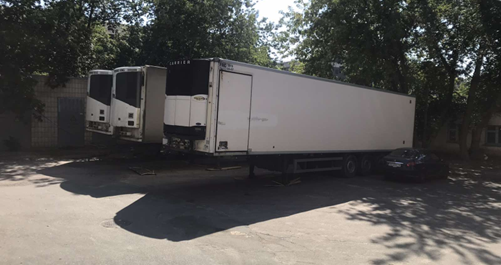
There is something else that is very painful to mention. On Oranzhereina Street there are four refrigerated trailers. This is our grief. Inside are the bodies and body fragments of soldiers and civilians from the first months of the war—Bucha, Irpin, Hostomel, Borodianka, Vorzel… And also the bodies of Azov heroes from Mariupol. Their burials have been postponed. Relatives are being searched for; when they arrive, DNA tests are conducted to establish family connection. It is clear that many of these people will never be claimed. A father and son went to war—both killed. A soldier died, and his entire family was bombed in their home. Or a soldier had no family at all. And countless other cases…
To address this national problem, a new military cemetery will be opened and arranged in the capital. Kyiv City Council approved the decision on July 14.
This is an extremely important issue initiated by the city authorities and long overdue. It concerns the creation of a military cemetery and places of honor for the defenders of Ukraine. Permission has already been granted to develop a land-management project for the cemetery along Olena Teliha Street in the Shevchenkivskyi district. The Ukrainian people are experiencing immense tragedy and undergoing enormous trials: our warriors, patriots, heroes of the Ukrainian nation are dying for the freedom and independence of Ukraine. It is the state’s duty to honor their heroism and preserve their memory. Therefore, we believe that all heroes whose bodies are now stored on Oranzhereina will receive their final resting place along the avenues of the new military cemetery. This place is symbolic in our history—next to the Babyn Yar ravine. Clearly, every era deserves its own military cemetery. The 21st century is no exception.
There were many cases when, especially in the first months of the war, commanders and officers asked us for help with burying fallen soldiers. About 150 such cases occurred. Today this process is organized and regulated by the state, but in the first months there were many difficulties even with this.
Civilians also sought help. A family member killed in a missile strike. Their apartment burned down, their money and belongings gone. There are countless examples of human grief; all are documented, and we have written requests. We helped however we could, organized burials, provided everything necessary—staff, transportation. Many families were in extreme hardship, and we arranged burials for them at cost.
Finally, another delicate problem in the first months of the war. This especially affected occupied territories and active-combat zones but also reached the capital. Within a few weeks, coffins ran out completely. Sawmills, funeral enterprises, and workshops were bombed. There were no deliveries of lumber. Sometimes burials had to be done in coffins without fabric lining. But all mourners understood; no complaints were made. On the contrary, they expressed gratitude for the mere possibility of a humane farewell and burial or cremation. Meanwhile, in neighboring regions—Chernihiv, for example—and in satellite towns like Irpin, Borodianka, Bucha, Brovary, Hostomel, bodies were buried in mass graves wrapped only in sanitary bags, blankets, carpets, etc., especially during fighting, shelling, and, of course, during occupation.
The topic of today’s memories was prompted by life itself. “Do not lose memory”—the war speaks to us in the voices of the dead. After it ends, all the fallen will receive a worthy burial, and monuments will appear at spontaneous and forced burial sites to honor heroes and commemorate innocent civilians who were murdered and tortured.
Meanwhile, we have horrifying numbers as of Independence Day: in Ukraine, during six months of Russian aggression, more than 1,097 children have been recognized as affected. As of August 24, it has been established that 374 children were killed and more than 723 injured to varying degrees. Zaluzhnyi has stated the number of fallen soldiers is 9,000. As for civilians: in Mariupol alone, the number exceeds 40,000. These numbers are approximate. New information about victims from active combat zones, temporarily occupied, and newly liberated territories arrives constantly. The most terrifying thing is that the total number of children killed as a result of Russian aggression is significantly higher than the official statistics reported by the Prosecutor General’s Office. There is still no way to document crimes committed by the occupiers in territories still under control, or those occurring there daily. The final word belongs to The Hague Tribunal. But for that, Ukraine must win the war.