
Family tree of Spain using the example of the memorial in Valencia
Traditions that have developed over many centuries are an integral part of European culture. European countries cherish the cultural heritage of past eras, harmoniously combining it with new traditions. According to Alla Landar, President of the International Association of Funeral Professionals, National Member of Ukraine in the World Federation of Funeral Executives (FIAT-IFTA) and head of the capital's private company ‘Peter the Great’ Alla Landar, what she encountered in Spain forced her not only to take a fresh look at European culture, but also to touch upon its ancient traditions, to see the living history of the development of the funeral industry in the Pyrenees, centuries-old traditions established by ancestors and revered by contemporaries.
Family crypts,
a living link between generations
A delegation from our association visited the Kingdom of Spain and its Mediterranean province of Valencia in the south-east of the Iberian Peninsula.
I would like to share with you my impressions of that trip and the valuable experience of encountering global funeral culture.
In the provincial capital of Valencia, we visited the Central Memorial Cemetery, located on one of the most picturesque streets, Avenida Gaspar Aguilar.
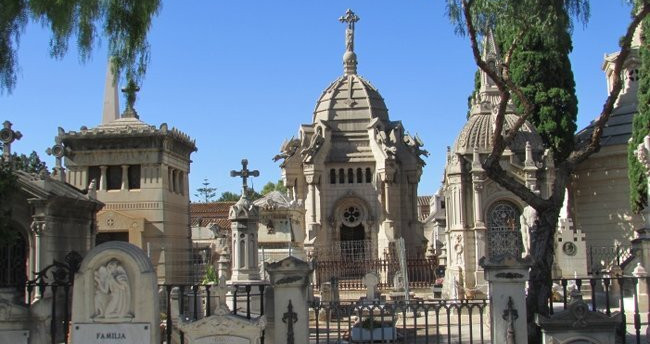
The main entrance and central alley of the crypts
This place is a vivid example of what living national memory means in practice, not just in words. The Cementerio Central de Valencia cemetery is rightly considered a museum of world masterpieces of architectural art, where architecture and sculpture are truly inseparable and united. The beauty and grandeur of the crypts, designed by renowned Spanish, French, German, Italian and Scandinavian architects of different centuries, cannot be described in words. It must be seen and felt. Here, you cannot shake the feeling that you are in paradise. Silence and bliss, peace and beauty, a true union of nature and history — these are the feelings that captivate you from the very first steps.
The picture that appears before your eyes is an open-air museum of Spanish crypts, each of which is a ‘family tree’. The central one, or as it is also called, the Main Cemetery of Valencia, is the oldest.
The open cemetery was established in the early 19th century, but soon suffered serious damage during the French invasion. In the past, due to the large number of palm trees on the territory, the place was known as the ‘Garden of Palms’.
Later, they were cut down when its second birth began. The second beginning, in 1886, was marked by the construction of pantheons. Initially closed and underground, they are immediately noticeable in the front rows of the plots. They resemble our old burials, for example, at the Lychakiv Cemetery in Lviv. These are massive slabs with underground crypts. And immediately behind them are the above-ground pantheons - crypts that seem to compete in beauty, decoration, monumentality, sculptural ensembles, and columns, transforming the entire space into a ‘Museum of Silence.’ Under this name, we can find it on the tourist map of Valencia.
The mausoleums of Juan Bautista Romero, Sebastián Monlam, Virginia Dotres, as well as the White and Llano families deserve special attention. The world-famous writer Blasco Ibáñez and the artist Joaquín Sorolla are also buried here.
One gallery of family crypts of incredible beauty follows another. Artists, bullfighters, writers, musicians, doctors, public figures, military personnel, personalities in the history of the city and the country who have made a significant contribution to Spanish culture and art. We see their names and those of their relatives and loved ones who have passed away in their final resting places. Angels, as messengers and sons of God, like harbingers of spirituality, accompany most of the burials in the form of sculptures, bas-reliefs and drawings.
Everything is skilfully divided into sectors, separated by massive columbarium walls, in which the Welsh have also been burying their deceased relatives for three centuries... and continue to do so today.
On closer inspection, you realise that each Spanish crypt, like the places within the columbarium walls, represents the ‘family tree’ of a single Spanish family.
From talking to visitors, it becomes clear that Spaniards visit family graves quite often. And not only on memorial or commemorative days. The main motive is communication, real and alive, a frank conversation with deceased relatives. On birthdays and death anniversaries, on memorial days and religious holidays, all current members of the family visit the crypts whenever possible.
"The crypts hold the wisdom and strength of many generations of my family. My family members and I often come here for advice and blessings. We close our eyes, pray to the Lord, and our entire family prays to God with us. Believe me, the power of such prayer increases tenfold, even a hundredfold! Then we simply talk and receive answers to many questions: how to act in a particular situation, how to avoid failure and achieve success, and we introduce newborns and those who are getting married to their ancestors. After such communication, there is a feeling of calm and peace, of the correctness of the chosen path or decision; it is as if we receive the consent of the family. Consent to our actions, ideas or plans, one of the visitors told us, ‘you can meet future newlyweds here on the eve of their engagement or wedding, parents on the eve of the birth of their first child, or even someone who is thinking of starting their own business, a new student or graduate...’.
Christian church on the main alley of the cemetery
In the cemetery of Valencia, as in all others in Spain, there are churches of various Christian denominations. The burial areas and religious rites of Christian and Muslim believers are separated. No one disturbs anyone else.
And one more thing, but in our opinion, very important. According to Spanish law, the deceased in this country must be buried or cremated within two days of death. It is clear that this often makes it difficult or even impossible for relatives and friends who work or live outside the country at that time to be present. Valencia's central cemetery was the first in the country, or more precisely since 2014, whose management offered an innovative and completely free service for the relatives and friends of the deceased. No matter where in the world they are at this sad moment, they can attend the funeral service via a virtual tour of the cemetery online. Confidentiality is paramount. Therefore, the family and friends of the deceased will be provided with a special access code to the broadcast and, subsequently, to the recording (copying or reproduction).
Gravestones and the living history of the family
Each gravestone or crypt, as well as the burial procedure for deceased Spaniards, testifies to the wealth of their family. At the same time, the question of the splendour or modesty of the family tree is undoubtedly secondary. The main thing is that relatives and loved ones are together after passing away.
Inside the crypt: on the left is a place for prayer, on the right are marble plaques for coffins and urns
The crypt of a famous family in this country is a whole complex of underground technical structures and a unique architectural ensemble, which also has space for further burials above ground. Below ground level, there is space for 6-8 coffins, and in the above-ground part of the crypt, there is space for 2 to 6. It may seem that the most distinguished members of the family are buried in coffins. This is not always the case. After all, all family members who leave this world are equally dear to the heart. The order of burial also plays an important role: when there is no more space for coffins in the crypts, cremation takes place. Urns fill all the free space, of which there is quite a lot left in the crypts. Enough for several generations to come.
The construction of huge family crypts is carried out in various architectural styles - from classic to high-tech. The underground and above-ground parts of such crypts are often designed for 12 or more coffins.
An alley of modern high-tech crypts
It is also possible to purchase places in underground crypts. They resemble modern graves, such as those in our Baikove Cemetery in Kyiv, with neat gravestones, crosses or sculptures at the head. However, in Spain, the gravestone is also the entrance to the crypt.
The remains of 4-6 relatives are buried underground in coffins, sometimes for several centuries, and all the free space is filled with urns containing the ashes of the recently deceased members of the family from the last three generations - the 20th and 21st centuries.
The deceased are also buried in family niches in the wall, although at first glance it looks like a columbarium, but this is not quite the case...
The depth of each niche is calculated to accommodate a coffin or sarcophagus: 2.4 m deep, 80-90 cm wide, 60-70 cm high. Such a brick cemetery usually consists of 5-6 floors or tiers. If the burial is new, the family first buries the coffin with the body of the first deceased in the niche. After that, the free space is filled with urns containing the ashes of other relatives. When there is not enough space, the coffin with the remains can be removed for further cremation, and then the ashes in the urn are returned. This frees up space for new inhabitants of the family crypt.
We saw many niches within the walls in which the remains of people have been hidden for five or six generations of the family.
‘Funeral homes’ and repatriation after death
One of the traditions of Spain's ancestral funeral culture is the search for and repatriation of the remains of family members who died at different times in other countries around the world. Spain is rightly considered one of the most successful and advanced countries in this difficult task. We witnessed the reburial in the family niche of remains brought from Latin America. The body was buried in a foreign land in the last century. Relatives living in Spain found this place, exhumed the remains, and after cremation, in the presence of the whole family, placed the urn in the family crypt.
The repatriation of remains is handled by funeral homes, whose activities have long been legalised in Spain, and unlike in Ukraine, this issue has long been resolved at the legislative level.
These same funeral homes provide a full range of ritual services, from transporting the body to the morgue to organising a full range of funeral services and planning the funeral itself.
Funeral homes can be either state-owned or private. At the same time, state structures are not given any advantages whatsoever. Funeral homes and private crematoriums often have one owner, or, more correctly, one family. As in the United States, Canada, Australia, and the European Union, this type of private business is mostly a family affair.
The authorities allocate land for burial — private cemeteries — to private enterprises on a long-term lease for a period of 30-50 years with the possibility of further contract extensions. Compliance with the law is monitored by the local municipality, and in rural areas — by the land or commune council.
State crematorium with no smoke as an indicator of modern filters
A few words about crematoriums. Near the Cementerio Central de Valencia cemetery, literally a few steps away, there is a large state crematorium, and on the territory of the cemetery itself, there is a much smaller private crematorium. The state-owned crematorium, which is much larger, can be recognised by two tall chimneys, from which water vapour is barely visible. Thanks to powerful filters, harmful emissions do not enter the environment, and smoke is completely eliminated.
The private crematorium is much more difficult to recognise. It is a small building surrounded by a beautiful landscaped area with fountains and even a mini botanical garden. In this place, death is not even a thought.
Modern private crematorium at the Cementerio Central de Valencia cemetery
The Spanish take special care to keep their cemeteries clean and tidy. There are comfortable rest rooms, toilets and sealed rubbish bins throughout the grounds. Gardeners are constantly at work, lawns are watered manually and automatically, and in many places, janitors are busy doing their job.
If a family signs a contract with the cemetery, the staff guarantees constant cleaning of the burial site, takes care of the greenery, decorates the graves with fresh flowers on the dates of death or birth of the deceased, cleans the interior of the above-ground part of the crypt, washing windows and stained glass, and wiping dust and dirt from sculptural compositions.
The owner of Tarantorio Infunerarias San Isidro in Madrid, the largest private operator in the country's funeral services market and a family business spanning four generations, told us in more detail about how funeral homes in Spain work. Luis Cifuentes Pedro's funeral home privately owns the most extensive network of private cemeteries and crematoriums in Spanish cities.
From his story, we learned that the main task of the funeral organisers is to minimise the pain of loss among the deceased's loved ones.
"We create a dignified, comfortable psychological environment and turn the farewell to the deceased into a solemn, culminating moment of their entire life. People pay their respects to the deceased. If you like, our task is to strengthen the belief of the deceased's relatives that the person has not gone anywhere, but has simply changed their place of residence," said my interlocutor.
Incidentally, Luis has recently become a pioneer of innovation and creativity in the funeral business, which has quickly gained popularity in Spain.
His funeral homes now hold open days, cemetery tours, and many other interesting events, especially on memorial days and religious holidays.
But let's return to Valencia. One of the best in Valencia is rightly considered to be the La Esperanza Servicion Funerarios funeral home, which translates from Spanish as ‘Funeral Service Hope.’
Entrance to the office and shop of the Hope funeral home in the city centre;
The funeral home, its main building
Its owner, Marisela Gonzalez, welcomed us with particular warmth and introduced us to her company's work.
The first thing that caught our eye was the grandeur and beauty of the main building. At the entrance is a clean, luxurious reception area with Schubert's music playing softly in the background. Spacious, long corridors, gleaming with marble and reflecting the light of crystal chandeliers, lead to rooms where relatives can rest and say goodbye to the deceased. At the end is a large hall for religious liturgies, connected to garages for hearses.
It was somewhat unusual for us that relatives say goodbye to the deceased through a glass partition. According to Marisela Gonzalez, this part of the ritual is dictated not only by sanitary standards but also by local customs. Often, the coffin is closed, and the deceased can only be remembered by a portrait taken during their lifetime, which is placed in a special niche.
While the coffin with the body is displayed in the farewell hall, classical music is played. These are not funeral marches by Chopin, but calm and sad pieces by outstanding composers of different eras. If desired, relatives can order live musical accompaniment. On the day of our visit, Schubert's ‘Ave Maria’ was playing.
Funeral homes have rooms where the relatives of the deceased gather before the procession or funeral service. Everything necessary for such occasions is provided there: coffee, tea, a set of medicines, and cold drinks. The design in no way reminds one of the mournful mission of all those present: paintings, sculptures, decorative colours... Everything is selected to match, with a colour scheme in soft and non-aggressive tones.
There is a room where the coffin with the body is kept until the day of the funeral. The ritual hall for farewells has Christian attributes. There is a place for the priest, a table with the necessary church utensils, sound equipment, soft lighting, and places for farewells. There is enough space for more than a hundred people at a time.
The hearse will drive directly into the room through a special glass gate, and the driver will not have to wait for the procession under the scorching sun. After all, all other rooms are air-conditioned.
The hearse will drive inside the funeral home directly to the farewell hall.
The room for storing the body of the deceased is connected to the embalming compartment. It is absolutely clean and equipped with a set of necessary medicines and chemicals.
The funeral home staff will do everything possible to ensure that the relatives and friends of the deceased are surrounded by care and everything necessary for the farewell and funeral process.
* * *
The funeral home ‘Ritual Service ’Nadezhda" in Valencia will take care of all the family's worries at the most difficult time for them. Here you will find a full range of funeral services and all the necessary ritual goods and accessories. But most importantly, this place becomes a second home for the family for several days.
Preparation of all necessary documents, funeral plan, agreements with the cemetery and crematorium, religious and memorial services, transport, storage and embalming.
There is obviously a lot of work to be done inside the house itself: providing a car to meet and distribute those arriving from other cities, and often from abroad, providing medical and psychological assistance if necessary. As well as caring for the burial site after the funeral. This includes flowers, plaques, and agreements with the cemetery regarding landscaping. And if necessary, full assistance in preparing documentation, and then in the construction of a new crypt with subsequent maintenance.
And, to conclude my story, I would like to say the following. We in Ukraine are waiting for the Verkhovna Rada to consider a new law ‘On Funeral Services in Ukraine,’ which will enshrine new articles for our state on funeral homes, private cemeteries and crematoriums, forest cemeteries, ecological and green burials. These ideas and principles, based on European and global experience, were developed by our public organisation, the International Association of Funeral Professionals, in collaboration with the Ministry of Regional Development and Infrastructure. The bill has been under consideration by parliamentary committees for a long time. We hope that our country will soon turn a new page in the development of funeral culture, and the development of a comprehensive service for saying goodbye to loved ones will open up a whole new range of services for us, which have been provided in Europe and around the world for centuries.
Brief background:
The International Association of Funeral Professionals is a non-governmental organisation registered in 2008. It has over 100 permanent members, including entrepreneurs and funeral service providers. The members of the organisation aim to revive national traditions and rituals and carry out environmental, cultural, educational and scientific activities to improve the organisation of funerals in Ukraine. In 2013, the first and only textbook, Funeral Services in Ukraine, was published for higher education institutions and special educational institutions that train specialists in the funeral sector. In the same year, the congress of the International Federation of Funeral Service Professionals (FIAT-IFTA) accepted the Association as a National Member from Ukraine into its organisation. The founder and President of the Ukrainian Association is Alla Landar.